
The best boilies do not catch in a place without fish: how to identify carp routes
You can have high-performance rods, impeccably executed mounts and boilies made from very good ingredients. However, if the mount ends up in an area that the carp do not frequent, the chances of an effective presentation decrease dramatically.
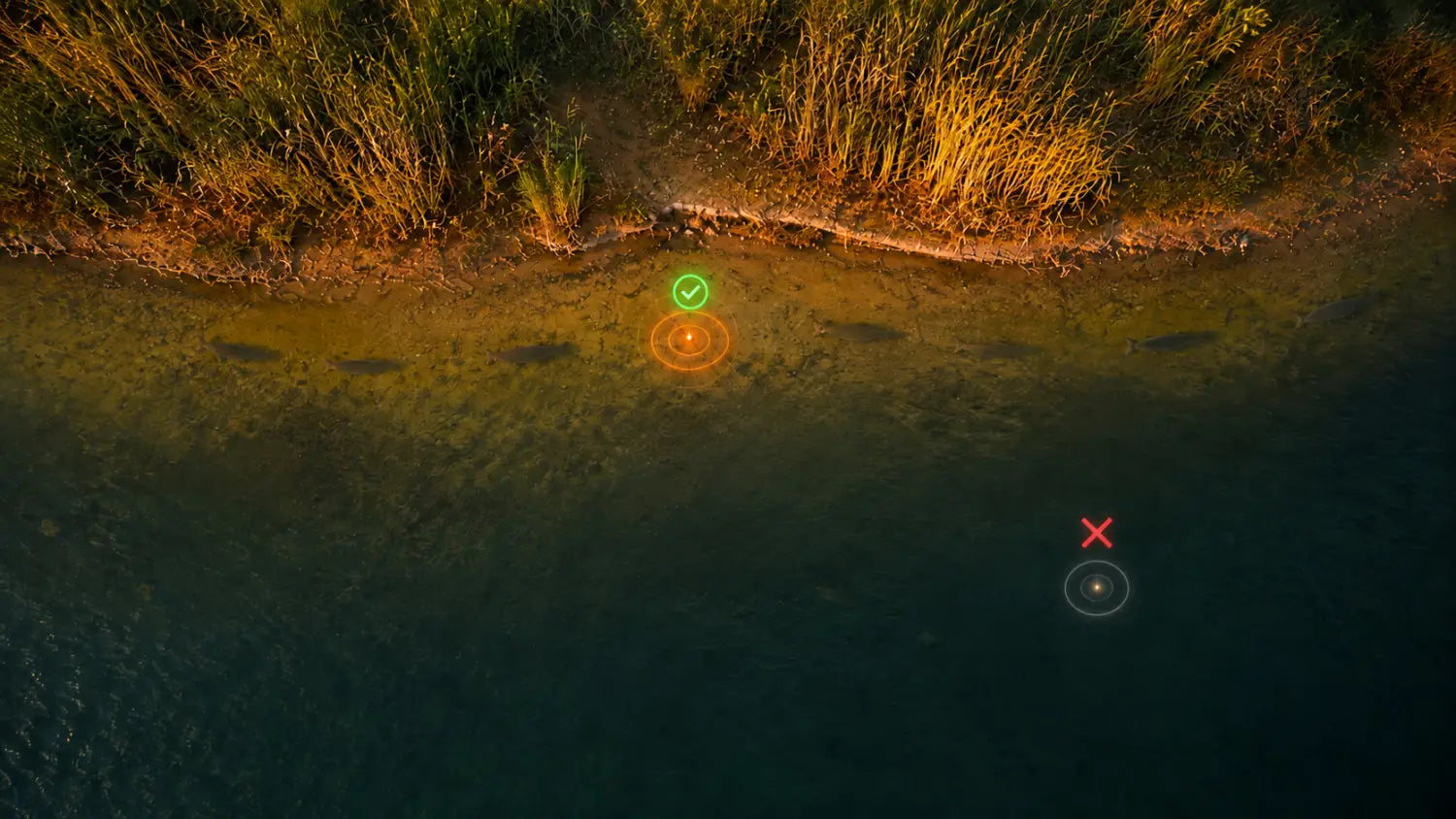
In carp fishing there is a tendency to pay a lot of attention to bait and tackle, but to leave the most important question behind:
Where are the fish and where do they move?
A good boilie can't fish an entire lake by himself. Its role really begins the moment it is placed in an area accessible to carp.
The location puts the mount in front of the carp. The lack of quality gives him a reason to stop.
What exactly is a carp trail?
The carp route should not be seen as a fixed path, which the fish follow every day at the same time.
Carp move between areas where they feel safe, resting places and areas where they find natural food. These movements are influenced by several factors:
- water temperature and oxygenation;
- wind direction and intensity;
- the depth;
- atmospheric pressure;
- time of day;
- the existence of natural food;
- substrate structure;
- water level;
- congestion and pressure exerted by fishermen.
Because of this, a productive route one morning can become less interesting in the afternoon or the next day.
The angler's goal is not to discover a permanent "highway" of carp, but to interpret water signals and identify the areas with the highest probability of transit or feeding at the time.
Crossing route, staging area or feeding ground?
Not every place where we see carp is automatically a place where it feeds. It is important to differentiate between three types of zones.
1. The crossing route
It is the corridor used by fish to move between two important areas. Carp can pass islands, reeds, shoals, channels, tongues or changes in depth.
In such a place, the presentation must be precise. A large bed of bait is not always necessary, because the initial objective is to intercept fish.
2. Parking area
It can be a safe place, protected by structures or at a comfortable depth. Carps can sit here without actively feeding.
If we see fish but don't get lures, it doesn't necessarily mean the lure is wrong. The mount may be in a resting area or at a different depth than the fish are running.
3. Feeding area
Here we can observe signs such as repeated bubbles, turbid water, raised sediments or concentrated activity on the substrate.
A confirmed feeding area is where we can begin to gradually build a bed of nada. Even then, the amount must be adapted to fish density, water temperature and carp reaction.
How do you identify the presence of carp before fishing?
The first few minutes of a game can be more important than the first kilos of nada.
Before you mount your rods, take time to observe the water. Sometimes 20-30 minutes spent on the bank without rushing can save hours of fishing in a spot without activity.
Watch the fish that show
Jumps, rolls and unusual waves can indicate the presence of carp. However, a showing fish does not necessarily feed at that point.
Note the direction in which it moves and notice if the activity repeats itself. A single fish can be random. Multiple occurrences on the same line may indicate a route.
Look for bubbles and cloudy water
Small and repeated bubbles, accompanied by a slight turbidity of the water, may indicate fish foraging on the substrate.
Not every bubble is produced by a carp, but repeating the phenomenon in a small area is worth investigating.
Analyze banks and visible structures
Reeds, submerged trees, islands, vegetation and less disturbed banks provide protection and can be orientation points for fish.
At the same time, fishing near obstacles must be done responsibly, with the right equipment and without endangering the fish.
Identify changes in depth and substrate
Sills, plateaus, channels, pits and transitions between hard substrate and mud can function as natural landmarks.
A seemingly uninteresting area on the surface may hide an important change underwater. The use of a marker, sounding rod or sonar, where permitted by regulation, can provide very valuable information.
It takes wind, temperature and oxygen into account
Wind can move water and concentrate natural food in a certain area. On some lakes, carp follow the wind-driven water. On others, especially in extreme conditions, I may prefer quieter areas.
In very hot periods, oxygenation becomes essential. Fish may seek better oxygenated water, shaded areas or certain depths, depending on the structure of the lake.
There is no rule that works identically everywhere. Direct observation should always take precedence.
Test the area before building the bed
One of the most effective approaches is discrete site testing.
Instead of introducing a large amount of nada immediately, you can start with a compact presentation: a precise mount and a small amount of food around it.
A product like PVA Bag Mix Brutality RED it can be used for a localized presentation and for testing an area without first creating an extensive bed of nada.
PVA bags are hard to go wrong with, provided you have the fish in the area.
The last part is essential. The PVA provides precision and appeal around the mount, but it cannot replace localization.
If there are no signs of activity, it does not automatically change the flavor of the boilies. Check first:
- the distance at which you fish;
- the depth;
- type of substrate;
- the position of the mount in relation to the route;
- the time at which the fish enter the area;
- the way the bait is presented.
Often times, moving the mount a few meters can count more than repeatedly changing the nade.
How do you turn a trail into a productive ford?
Once you've identified a route, the next goal is to give the carp a reason to slow down, scout the area, and possibly come back.
Start with a moderate amount and observe the response.
If there are signs, signs of feeding or fish returning to the area, you can gradually fill the bed of bait. If there is no confirmation, entering an increasing amount does not necessarily solve the problem.
In free fishing, where a balance between quality, quantity and cost is needed, Boilies EcoCrab may represent the base of the nada bed. The combination of Crab & Plum and the mix based on grains, lactic proteins, amino acids and seeds allow a balanced approach for regular parties.
On intensively fished waters or when we want a very concentrated area around the mount, Boilies Red Brutality can be used more selectively. Its premium formula with LT Fishmeal, Robin Red, Squid Meal, Lactic Protein, Crustacean and Soluble Ingredients recommends it for a carefully constructed presentation.
A balanced variant can be:
- Boilies EcoCrab for the main volume of the nada bed;
- Boilies Red Brutality in a more concentrated amount near the mount;
- PVA Bag Mix Brutality RED for accurate presentation around the hook.
This strategy does not guarantee a catch. It does, however, provide a logical construction of the ford after the presence of the fish has been confirmed.
The real role of a quality boilies
A quality boilies should do its job the moment the carp arrive in the area.
It must offer:
- suitable ingredients and a balanced formula;
- clear food signals;
- consistency between batches;
- predictable behavior in water;
- the possibility of building a repeatable strategy.
What no serious manufacturer should promise is that a product will find the fish on its own or that it will guarantee catches.
At Myon Baits we can control the quality of raw materials, recipe development, production process and product consistency. We cannot control where the angler casts the rig, lake conditions or the availability of carp to feed.
Therefore, the best nada is the one used in the right place, in the right amount and at the right time.
Signals that you need to adjust your strategy
A game with no tricks does not automatically mean that the ball must be changed.
Before you give up on your chosen path, watch for some signals:
- carp constantly show in another area;
- notice activity at a different distance or depth;
- you get fake traits or thread touches, but no catches;
- the fish circulate in the water mass, and the mounts are exclusively on the substrate;
- the area has been excessively disturbed by launches and nudges;
- the activity has moved with a change in wind or temperature;
- you put in too much bait before confirming the presence of the fish.
In such situations, repositioning a rod may be the first test. It is not mandatory to move the entire strategy at once.
A simple plan for the first hour of fishing
First 15 minutes: observe
Look at the surface of the water, wind direction, banks, reeds and areas of activity. Don't rush to launch just because you hit the water.
Minutes 15–30: Investigate
Check depth and substrate. Identify any thresholds, plateaus or color between the safety and feeding areas.
Minutes 30–45: Test accurately
Place one or two mounts in different areas, each with a low and controlled amount of nada. Note the distance and use clear landmarks on the shore to be able to return to the same point.
Minutes 45–60: decide
Compare the received signals. If an area shows activity, start building the progressive ford. If there is no confirmation, adjust the position before increasing the amount of nada.
This plan isn't a hard and fast rule, but it forces you to make decisions based on water, not just the products in your bag.
Frequently asked questions about carp trails
Do the carp follow the same route every day?
Not mandatory. Some trails can be used repeatedly, but conditions change. Temperature, wind, oxygenation, fishing pressure and food availability can alter fish movement.
Can the nada bring the fish from a distance?
An attractive lure can encourage nearby carp to scout and stay in an area. However, we should not rely on the idea that it will attract fish from every corner of the lake. Localization remains the first step.
How much nada should I start with?
The amount depends on fish density, temperature, game duration, lake regulations and carp reaction. On pressurized water it is often safer to start moderately and top up as you get confirmations.
What do I do if I see carp in the area but I don't have traits?
Check running depth, mount presentation, substrate and time of day. The fish may be present without feeding on the bottom or may pass within a few meters of the mount.
Bottom line: find the carp before you try to feed it
You can nurse with a really good boilies. You can have high-performance equipment and a mount you can trust. But if you don't identify the area where the fish are moving or fail to bring them in and keep them on the ford, all these advantages remain unused.
The correct order is simple:
observe, locate, test, anticipate and adapt.
Quality products do not replace the experience of the fisherman. They complement a good decision and help turn a well-chosen area into a ford that carp can confidently accept.
At Myon Baits we promise no catches. But we assume what we can control: the quality of the ingredients, the attention paid to the recipes and the consistency of the products we make available to fishermen.
Stretched thread!
Mark Molnar
Founder of Myon Baits